
Building happy, healthy lives in New Wortley & Armley
23 July 2025
We recently caught up with New Wortley Community Association. They told us about what they do, their Lunch Club, and what they need for the future.

Can you tell us a bit about New Wortley Community Association?
New Wortley Community Association manages New Wortley Community Centre & Wellbeing Centre, based in the New Wortley area of West Leeds. We offer a wide range of services, projects and activities that aim to help local people living in New Wortley & Armley Ward to access what they need to live happy, healthy lives.
Our projects address personal issues community members face on a day to day basis including financial struggles, health inequalities, access to training/volunteering & employment opportunities or social groups and activities to help reduce social isolation and loneliness. Current activities include cooking, walking groups, gardening, music/jam sessions, dance, knitting, healthy eating and various lunch clubs and themed cafes.
What has funding from Lunch Clubs enabled you to do?
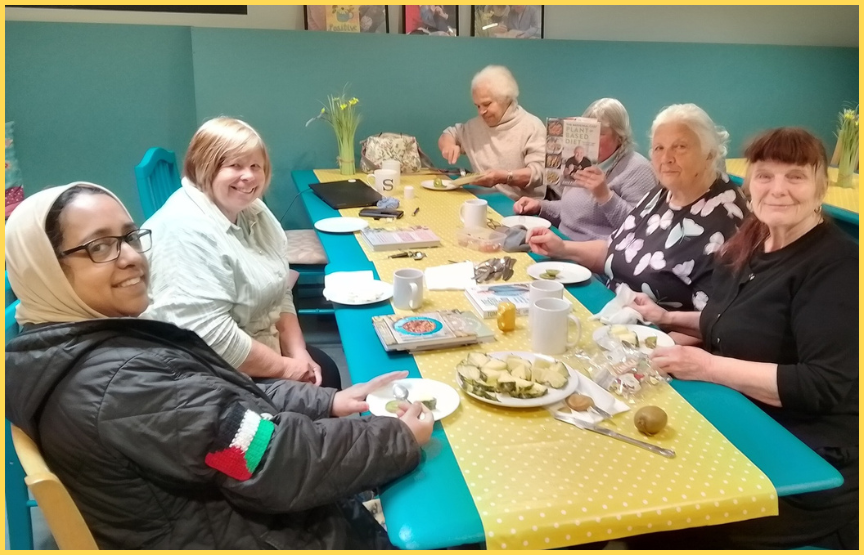
Our Thursday Lunch Club provides an opportunity for local people to come together in a safe, inclusive environment to enjoy a hot meal together. Food is often the gateway to accessing the wide range of other services that we offer at the centre and we have many examples of attendees who now not only access Lunch Club but have been successfully signposted into our Women’s Group, Men’s Pie Club and even volunteering on our allotment growing vegetables that are used at Lunch Club. Lunch Club is often the first step when people engage with the centre so it is important that we create the right atmosphere and allow people to be themselves and develop a wider relationship with our team that can lead onto addressing other needs such as pantry membership, support with fuel bills and debt management. It’s a catalyst for change in the lives of many of its members.
Can you tell us about the impact of what you do on the people you work with?
We welcome anyone over the age of 18 living in the local area to attend our Lunch Club and have many examples of where investing time listening to people and encouraging them to attend can make such a difference over a period of time to their overall health and wellbeing.
John used to sit on the bench outside the centre and ask us for “any fruit or veg we were throwing out” from our Community Pantry. We would give him what we had to start to build a relationship with him. It took a long time to build a trusted relationship with us due to previous his health struggles and a distrust of people offering to help him. After about 3 months of periodically inviting John to Lunch Club he finally took the plunge and attended.
We are very proud of John. He now comes to Lunch Club every week and we have also introduced him to our Men’s Pie group which is immediately after Lunch Club finishes. He is trying new foods (he is very careful about what he eats and won’t eat anything processed or that he doesn’t know what is in it). John is still quite lonesome but has excellent relationships with staff at the centre, our pantry coordinator (who has done a lot of ‘mythbusting’ around food and what is healthy to eat), and also our Pie Club Coordinator.
John said “Everyone at the centre is so kind – they have helped me enormously. I like the Lunch Club.”
In the last month John has become a member of our Community Pantry, a way of accessing affordable food and seeks support from our Pantry Coordinator to do this.
What are some of the biggest challenges you face as an organisation?
These are indeed very challenging times – there seems to be much less funding around post pandemic. Over successive years our running costs have continued to rise as have salary costs and this is now having a cumulative negative effect on our projects and services as we now have some projects that have been funded at the same level for 4 or 5 years. This is now starting to impact on the amount available to deliver services. We need to retain good staff and have progression pathways and to do this we pay them at least the living wage and will continue to do so. We have a duty to protect those who care as well as the people we care for.
How is your organisation preparing for the future, and what kind of funding is needed?
First and foremost we listen to our community – they tell us what is needed and we work with funders to deliver the support that is needed. We continue to review our offer and respond to the financial challenges we are facing but is it becoming increasingly difficult. Most funding is still allocated on a restricted funds basis that doesn’t allow for flexibility in how it is spent. Trusted organisations know their communities and act in their interests and if funders recognised this through unrestricted funding it would be a big step forward.